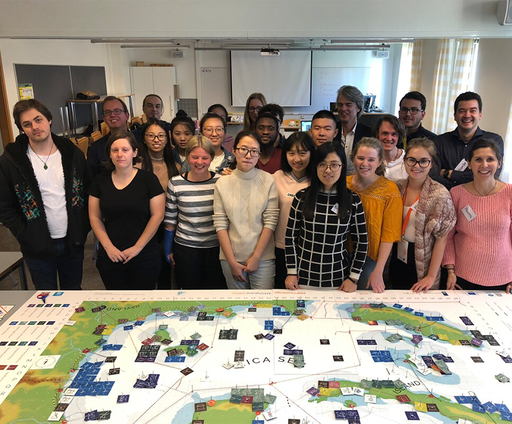
It is important to educate the next generation of Maritime Spatial Planners. To built a global community of future decision makers, ready to work with smart technologies. The MSP Challenge has been designed to engage. The learning process in the MSP Challenge is highly interactive and ‘unfolds’ like in a computer game. Step by step, the users discover the rich geo, marine data and sectoral information. They come to understand how the maritime economy influences the marine environment, and experience the strategic behaviour of decision-makers and stakeholders.
Use: Nearly a thousand students and young professionals from various parts of the world have experienced the MSP Challenge as an interactive learning environment. Copies of the board game are available at many educational institutions and faculties such as environmental sciences, urban planning, and ocean governance. The simulation game has been adopted as a recurring learning event – such as summer schools – by universities around the world. From Delft, Oldenburg to Venice. From Canada, Finland, to the Maldives and China.
Learning Concepts:
Interactive learning
Experiential learning
Game-based learning
Constructivist learning
Professional learning
Learning communities
Learning Objectives:
What is Maritime Spatial Planning?
What does a maritime spatial planner do?
Different ways to arrange and manage a MSP process?
How can stakeholders be involved into MSP?
Role of data, evidence and science in MSP?
Transboundary coordination in MSP? Sea as complex, socio-technical system?